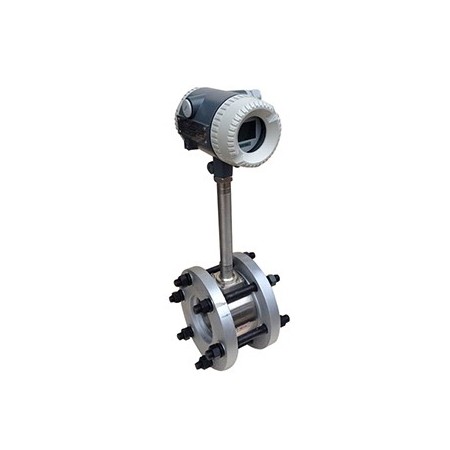
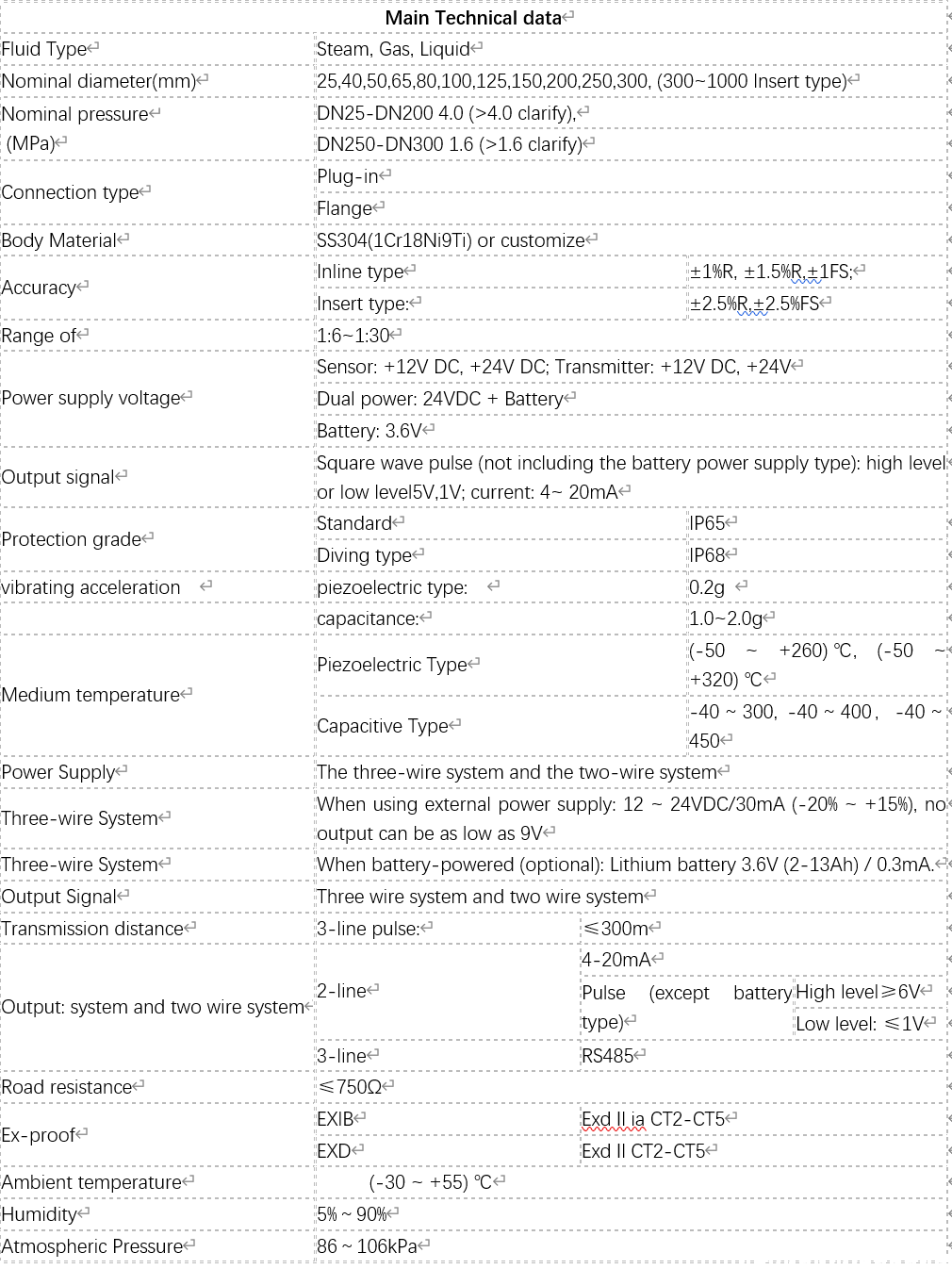
The RBVF series Vortex flow meter is based on Karman (Carmen) vortex principle research and production, mainly for industrial piping dielectric fluid flow measurement, such as gas flow rate of gases (air, oxygen, nitrogen, coal gas, natural gas, chemical gas, etc.), liquid, steam and other media. The product adopted advanced differential technique, together with measurement of isolating, shielding and filtering, it had possessed better anti-vibration performance and signal stability and are used in automatic control system as flow transmitter.
Vortex Flow Meter has 2 types Installation methods:
Inline Vortex Flow Meter
Flange
Clamp(wafer type)
Insertion Vortex Flow Meter
Classified as a vortex flow meter, this device utilizes a law that was theoretically proven by Theodore von Karman in 1912. When there is a column-shaped obstruction (vortex shedder) in flowing fluid, it will generate alternating vortices downstream. The flow velocity of the fluid and the vortex generation frequency are proportional to each other. Therefore, detecting the number or pulse of vortices makes it possible to measure flow. The main method of detection involves sensing the vortex vibration with a piezo element. However, a more robust method utilises ultrasonic waves to detect the vortex vibration.
Vortex flow meters are flow sensors that detect the frequency of vortices shed by a bluff body placed in a flow stream. The frequency of the vortices is proportional to the flow velocity. Vortex flow meters are used to measure the flow of liquids and/or gases and are best suited for turbulent flow with a Reynolds number greater than 10,000. Some devices can accommodate mixed-phase materials such as steam. Others can measure liquids with suspended solids (slurries). The advantages of this device are low initial set up costs, and low maintenance requirements when used in clean flow conditions. Vortex flow meters are also insensitive to temperature, pressure, and viscosity. The disadvantage of a vortex flow meter is that there is a low to medium pressure drop due to the obstruction in the flow path.
The basic principle for a vortex flow meter is that a barrier is placed in a moving stream. As the flow goes around the object it alternates creating vortices (swirls of media) from the top or bottom of the object. The swirls are created from the increase in pressure and decrease in velocity on one side of the object and a decrease in pressure and increase in velocity on the other side. This process creates a swirl on one side of the object and as the process alternates, a swirl is created on the other side.