High-Purity Flow Monitoring in Semiconductor Manufacturing
Technical FAQ: High-Purity Flow Monitoring in Semiconductor Manufacturing
Q1: Why is "Non-invasive" sensing critical for Semiconductor UPW systems?
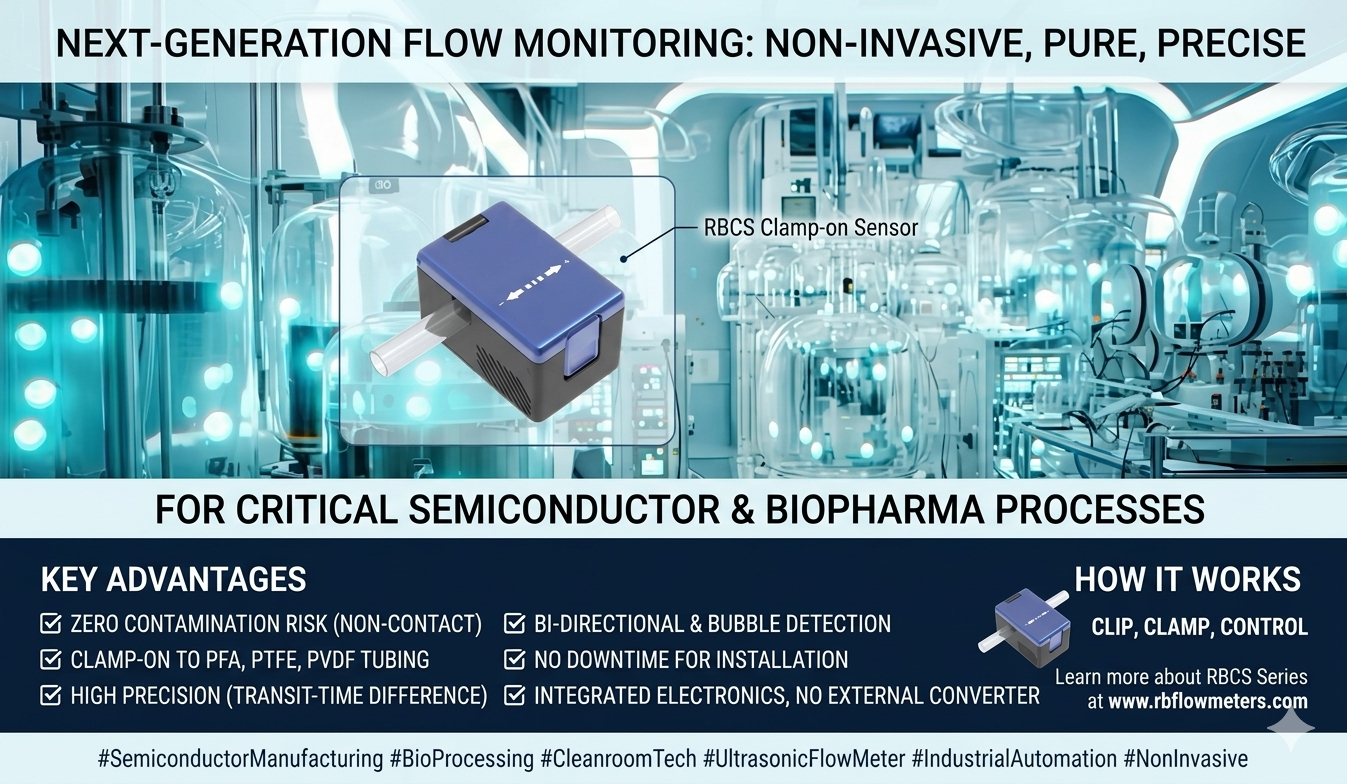
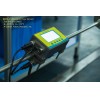
A: In semiconductor fabrication, Ultra-Pure Water (UPW) must maintain PPT (parts-per-trillion) levels of purity. Traditional in-line flow meters, which have wetted parts or electrodes, pose a significant risk of metallic ion leaching and particle shedding. The RBCS Series utilizes a clamp-on ultrasonic design that never touches the process fluid. This ensures zero contamination, zero pressure drop, and maintains the absolute integrity of the UPW loop.
Q2: How does the RBCS Series overcome signal interference caused by rigid PFA/PTFE tubing?
A: Rigid plastic tubing like PFA has unique acoustic impedance properties that can refract ultrasonic signals. Our sensors are engineered with Acoustic Coupling Compensation technology. By using a specialized silicone/rubber interface and digital signal filtering, the RBCS accurately "tunnels" through the tube wall to measure the fluid velocity directly. This allows for stable measurements even on standard 1/4", 3/8", 1/2", and 1" PFA tubing without signal drift.
Q3: What is the technical logic behind the Integrated Bubble Detection feature?
A: Micro-bubbles in etching or cleaning fluids can cause catastrophic defects on wafers. The RBCS Series employs a Dual-Parameter Analysis algorithm. It monitors both the ultrasonic time-of-flight and amplitude attenuation. When a bubble passes through the sensing field, the signal amplitude drops significantly; the onboard DSP (Digital Signal Processor) identifies this pattern instantly, triggering an alarm via RS485 or digital output before the bubble can reach the process chamber.
Q4: Can these sensors withstand the harsh chemical environments of CMP and Wet-Bench tools?
A: Absolutely. Since the sensor is clamped to the outside of the tubing, the electronics are physically isolated from the corrosive media. Unlike electromagnetic meters that require expensive Tantalum or Platinum electrodes to survive acids, the RBCS series is intrinsically immune to chemical attack. The rugged outer housing is also resistant to chemical splashes common in cleanroom environments.
Q5: Is it possible to install or replace sensors without shutting down the production line?
A: Yes. This is one of the primary advantages for 24/7 semiconductor fabs. The "Clip-and-Go" mechanical design allows for installation on existing lines in seconds without cutting pipes or stopping the flow. There is no need for system re-pressurization or air-bleeding, significantly reducing the Total Cost of Ownership (TCO) and eliminating downtime risks.
Q6: How does the RBCS series integrate into a Smart Fab (Industry 4.0) environment?
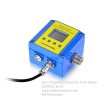
A: To support advanced SCADA and MES integration, the RBCS Series comes standard with RS485 Modbus RTU digital communication. It also provides high-resolution analog outputs (4-20mA / 0-5V) for real-time flow rate tracking. This connectivity allows fab engineers to perform predictive maintenance and maintain a full digital footprint of chemical consumption and UPW usage.
???? Pro-Tips for your Web Page:
• Keywords to Highlight: Use bold text for terms like PPT Purity, PFA Tubing, Zero Contamination, and Bubble Detection.
• Call to Action (CTA): At the end of the FAQ, add: "Have a specific tubing size or chemical compatibility question? [Request a Technical Consultation]"