FAQ: What are the Straight Run Requirements for Insertion Magnetic Flow Meters?
Q: Why is the straight pipe run so critical for insertion magnetic flow meters?
A: Insertion magnetic flow meters operate based on Faraday's Law of Electromagnetic Induction. Their accuracy relies on the fluid passing the electrodes having a uniform, symmetrical, and fully developed flow profile.
Flow disturbances caused by elbows, valves, pumps, or reducers create swirl, jetting, or profile asymmetry. If the insertion probe samples flow in a disturbed area, the single-point or multi-point measurement will not represent the true average velocity of the pipe cross-section. This leads to significant measurement errors (typically over-registration or fluctuation). Sufficient straight pipe lengths allow the flow to "settle" and restore a predictable profile.
Q: What are the standard recommended straight run lengths?
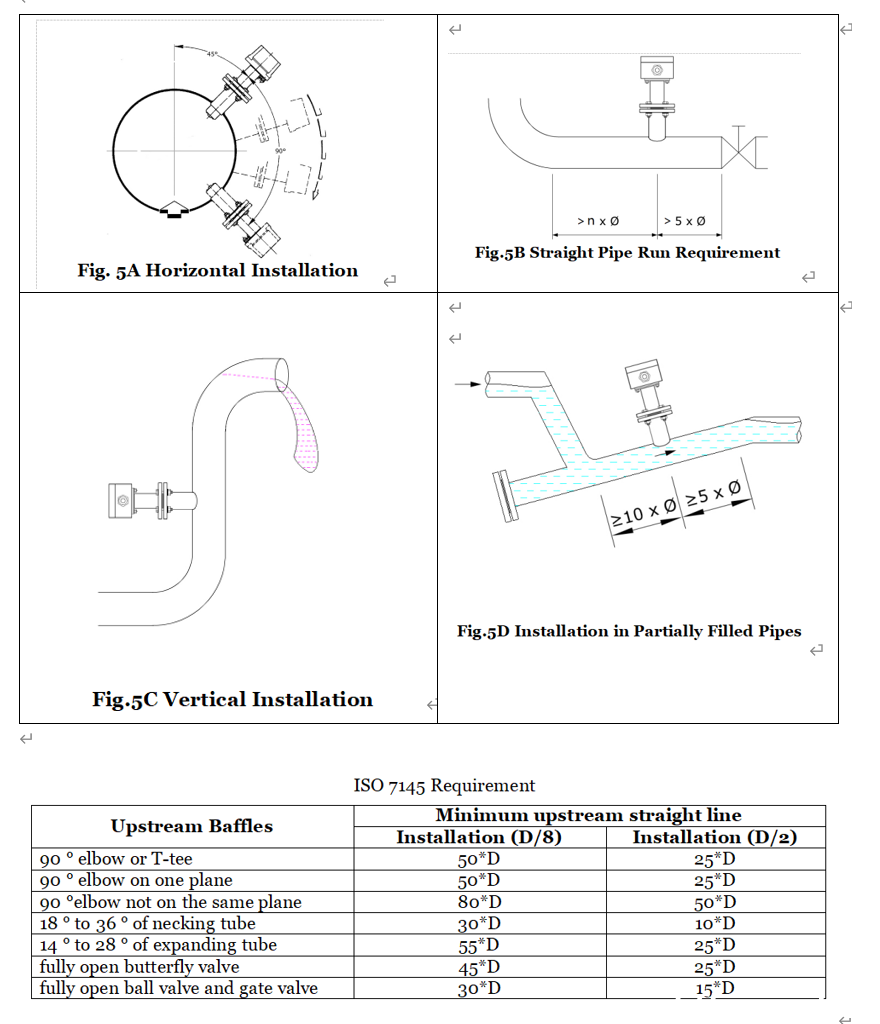
A: According to ISO 7145 and general industry practice, the required lengths are expressed in multiples of the internal pipe diameter (D).
Upstream Disturbance Type Upstream Minimum Length Downstream Minimum Length
Single 90° Elbow or Tee ≥ 20D ≥ 5D
Multiple Elbows (Same Plane) ≥ 25D ≥ 5D
Control Valve (Any Position) ≥ 30D ~ 50D ≥ 5D
Pump Discharge (After Check Valve) ≥ 30D ≥ 5D
Fully Open Gate Valve / No Disturbance ≥ 10D ≥ 5D
Example: For a DN100 (4-inch) pipe, 20D equals 2 meters (approx. 6.5 feet) of straight run.
Q: What if I don't have enough space for 20D straight run?
A: This is a common field constraint. Here are the recommended mitigation strategies:
1. Use Multi-Point Averaging Probes: For larger pipe sizes (e.g., > DN500 / 20"), consider a multi-point insertion probe that averages velocity across the entire cross-section. This design significantly mitigates profile distortion and can reduce the upstream requirement to as low as 10D.
2. Avoid the Worst-Case Locations: Never install the probe immediately downstream of a control valve or directly at the pump discharge flange. If space is tight, move the probe upstream of the control valve.
3. Install a Flow Straightener: A tube-bundle straightener can eliminate most swirl within 5D to 8D of pipe length.
4. In-Situ Calibration: Perform a field calibration against a portable clamp-on ultrasonic flow meter to adjust the meter's K-factor for the specific distorted profile.
Q: Do straight run requirements change for vertical pipes?
A: The required length (e.g., 20D) remains the same regardless of orientation. However, vertical installations (flow moving upward) are often preferred because they guarantee a full pipe condition. Insertion meters rely on the probe being fully submerged; an upward vertical line ensures air pockets do not accumulate at the sensor tip.
Q: From which point do I measure the straight run distance?
A:
- Upstream: Measured from the downstream face of the disturbance (e.g., the weld line of the elbow) to the center of the tap hole where the probe is inserted.
- Downstream: Measured from the center of the tap hole to the upstream face of the next fitting.